Concepts
Companion to the day-3 slides. Day 3 is where Rust starts to feel like Rust: structs and enums model biological data faithfully; Option, Result, and iterators replace exception handling and “loops with state” with composable, type-checked alternatives.
Structs
struct GenomicInterval {
    chrom: String,
    start: u64,
    end: u64,
}

let iv = GenomicInterval {
    chrom: "chr1".to_string(),
    start: 1000,
    end: 2000,
};
println!("{}-{}", iv.start, iv.end);
Field-by-field construction. Field privacy, derives, and tuple structs all in the → Book chapter on structs.
Enums — sums of variants
enum Strand {
    Plus,
    Minus,
}

enum Variant {
    Snp { pos: u64, alt: u8 },
    Insertion { pos: u64, bases: Vec<u8> },
    Deletion { pos: u64, len: u64 },
}
Two flavours:
- C-style (
Strand): just tagged variants with no data. Compiles to a single small integer. - Sum type (
Variant): each variant carries its own data. The enum is large enough to hold any of its variants, plus a tag.
The compiler insists you match every variant — see “exhaustive matching” below.
Methods — impl blocks
impl GenomicInterval {
    fn new(chrom: String, start: u64, end: u64) -> Self {
        Self { chrom, start, end }
    }

    fn length(&self) -> u64 {                // borrow self read-only
        self.end - self.start
    }

    fn shift(&mut self, by: u64) {           // borrow self mutably
        self.start += by;
        self.end   += by;
    }
}
First parameter is &self, &mut self, or self (consuming). Methods are called with iv.length(). Associated functions (no self) like new are called with GenomicInterval::new(...).
#[derive(...)]
#[derive(Debug, Clone, Copy, PartialEq, Eq)]
enum Strand { Plus, Minus }
The compiler writes trait implementations for you. The ones you will use this week:
Debug— enables{:?}formatting. Almost always.Clone—.clone()deep-copies. Almost always.Copy— assignment copies, no move. Only for types whose entire contents live on the stack (noString, noVec).PartialEq—==and!=. AddEqif equality is reflexive (most types — butf64is famously not).
Option<T> — values that may be absent
enum Option<T> {
    Some(T),
    None,
}

fn first_g(seq: &[u8]) -> Option<usize> {
    for (i, &b) in seq.iter().enumerate() {
        if b == b'G' { return Some(i); }
    }
    None
}
Option<T> replaces null. The compiler will not let you use the inner value without first checking which variant you have:
match opt {
    Some(x) => use_it(x),
    None => default(),
}

if let Some(x) = opt {           // shorthand when you only care about Some
    use_it(x);
}

let x = opt.unwrap_or(0);         // value, or a default
let x = opt.expect("must be Some by here"); // panic with message if NoneResult<T, E> — operations that can fail
enum Result<T, E> {
    Ok(T),
    Err(E),
}
Result is Option’s richer sibling: when something fails, the error gets its own value of type E. Use it for recoverable failures (bad input, missing files, parse errors).
The ? operator
? means “if this is Err, return it from the enclosing function; otherwise unwrap and continue”:
fn parse_region(s: &str) -> Result<(String, u64, u64), ParseError> {
    let (chrom, rest) = s.split_once(':').ok_or(ParseError::MissingColon)?;
    let (start_s, end_s) = rest.split_once('-').ok_or(ParseError::MissingDash)?;
    let start: u64 = start_s.parse().map_err(|_| ParseError::InvalidStart)?;
    let end:   u64 = end_s  .parse().map_err(|_| ParseError::InvalidEnd)?;
    Ok((chrom.to_string(), start, end))
}
The enclosing function must itself return Result (or Option) for ? to be valid.
Exhaustive matching
The compiler refuses to compile a match that does not cover every possible input value. The wildcard _ matches anything you have not listed:
match codon {
    b"ATG" => Some(b'M'),
    b"TAA" | b"TAG" | b"TGA" => Some(b'*'),
    _ => None,
}
This same mechanism catches “I added a new enum variant and forgot to update X” bugs at compile time.
Iterators
Iterators are lazy. They produce values one at a time, only when asked. Adaptors (map, filter, take) build a chain; consumers (collect, count, sum, fold, for) drive it:
let gc_count = seq.iter()
    .filter(|&&b| matches!(b, b'G' | b'C'))
    .count();

let upper: Vec<u8> = seq.iter()
    .map(|&b| b.to_ascii_uppercase())
    .collect();

let mean_gc: f64 =
    sequences.iter().map(|s| gc_content(s)).sum::<f64>() / sequences.len() as f64;
Iterator chains compile to the same machine code as a hand-written loop (zero-cost). Use them whenever the body is “for each item, do X, produce a value”.
Useful slice and string methods
seq.windows(3)            // every consecutive 3-byte window
seq.chunks(8)             // every 8-byte chunk (last may be shorter)
seq.iter().rev()          // reverse iteration
seq.iter().enumerate()    // (index, value) pairs

s.split_once(':')         // returns Option<(&str, &str)>
s.lines()                 // iterator over lines
s.starts_with('>')        // bool
s.parse::<u64>()          // returns Result<u64, _>
Closures
let add5 = |x: i32| x + 5;
let squares: Vec<i32> = (0..10).map(|i| i * i).collect();
Closures borrow or move values from the surrounding scope. The three closure traits — Fn, FnMut, FnOnce — describe how they relate to their captures. For day 3 you can ignore the distinction; iterator combinators accept any of them.
HashMap and the entry API
use std::collections::HashMap;

let mut counts: HashMap<Vec<u8>, usize> = HashMap::new();
for window in seq.windows(k) {
    *counts.entry(window.to_vec()).or_insert(0) += 1;
}
entry(key).or_insert(default) returns a &mut V to either the existing value or a freshly-inserted default. Dereference and mutate in place. This is the canonical histogram-building pattern.
Recursive types
enum Node {
    Leaf { name: String, branch_length: f64 },
    Internal { branch_length: f64, children: Vec<Node> },
}
A type that contains itself directly (left: Node) has unbounded size and the compiler refuses. The fix: indirection through a heap pointer. Box<Node> is the most common choice. In our case, Vec<Node> already provides indirection — the children live on the heap, the enum itself is a fixed size.
Recursive functions
fn count_tips(node: &Node) -> usize {
    match node {
        Node::Leaf { .. } => 1,
        Node::Internal { children, .. } => children.iter().map(count_tips).sum(),
    }
}
Rust does not guarantee tail-call optimisation, so very deep recursion can overflow the stack. For trees of biological depth this is fine; for sequences of length 10^9 it is not — use iteration there.
Dynamic programming as iterative recursion
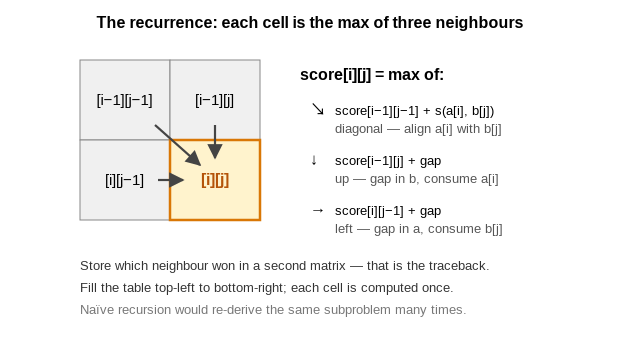
When a recursive formula visits the same subproblem many times, fill a table once instead. The recurrence becomes a nested for loop; each cell computed exactly once. The day-3 alignment exercise is the canonical example.