Exercise: A codon table with Option
Goal
Write translate_codon(codon: [u8; 3]) -> Option<u8>: given three DNA bases, return the corresponding amino acid as a single ASCII letter, or None if the codon is unrecognised (typically because it contains an N or other ambiguity character).
Stop codons (TAA, TAG, TGA) return Some(b'*') — they are recognised, they just mean “end translation here”.
Background
The standard genetic code maps each of the 64 possible DNA triplets to one of 20 amino acids or a stop. Translation is the inner loop of every protein-coding-gene analysis. A robust translator returns:
Some(amino_acid)for the 61 sense codonsSome(b'*')for the 3 stop codonsNonefor everything else (anything containing N, IUPAC ambiguity codes, lower-case characters mixed with garbage, etc.)
Option<T> is Rust’s “this might be there or not” type. Unlike null in many other languages, the compiler forces every caller to handle both cases — there is no way to accidentally use a None as if it were a value.
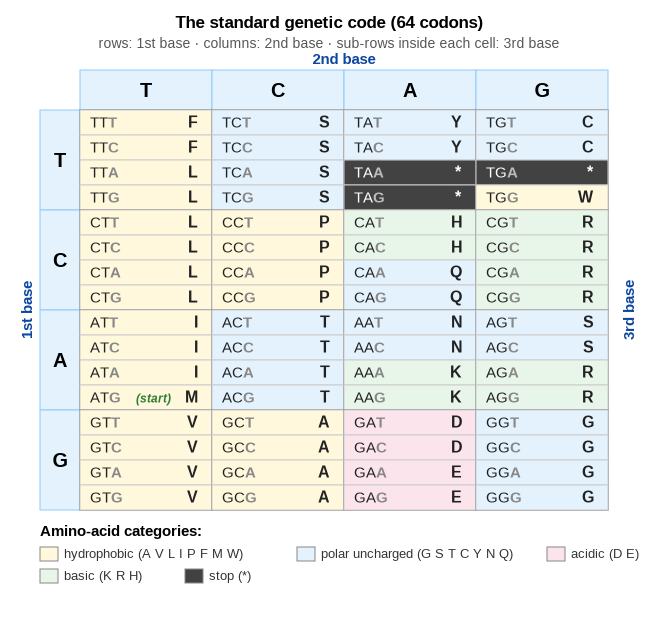
ATG is the universal start codon.
The exercise
cd day3/ex-codon-tableImplement the full standard codon table. Make all nine tests pass.
How to run
cargo test
cargo run -- ATG    # M
cargo run -- TAA    # * (stop)
cargo run -- ATN    # None  (contains an N)
cargo run -- atg    # M     (case-insensitive)
Hints
The standard codon table is given in upper case. Convert each byte with u8::to_ascii_uppercase at the start so the match itself only handles upper case:
let upper = [
    codon[0].to_ascii_uppercase(),
    codon[1].to_ascii_uppercase(),
    codon[2].to_ascii_uppercase(),
];Byte string literals b"ATG" have type &[u8; 3]. Inside match patterns, they match an array of bytes — so you can write:
match upper {
    b"ATG" => Some(b'M'),
    // ...
    _ => None,
}
Wait — upper has type [u8; 3] and the pattern b"ATG" is &[u8; 3]. Won’t the types mismatch? In modern Rust they do not: match patterns auto-dereference. (If you ever get a type error here, you can always write match &upper { b"ATG" => ... } to be explicit.) See the Rust reference on match ergonomics.
|
Most amino acids correspond to several codons (this is the genetic code’s redundancy). Use | alternatives to group them on a single arm:
b"TTA" | b"TTG" | b"CTT" | b"CTC" | b"CTA" | b"CTG" => Some(b'L'),  // Leucine
b"TAA" | b"TAG" | b"TGA" => Some(b'*'),                              // Stop
The catch-all _ => None at the end handles every codon containing an N (or other non-ACGT character) — anything we did not list explicitly.
The 20 standard amino acids (each followed by its codon set):
| AA | Codons |
|---|---|
| F | TTT TTC |
| L | TTA TTG CTT CTC CTA CTG |
| I | ATT ATC ATA |
| M | ATG |
| V | GTT GTC GTA GTG |
| S | TCT TCC TCA TCG AGT AGC |
| P | CCT CCC CCA CCG |
| T | ACT ACC ACA ACG |
| A | GCT GCC GCA GCG |
| Y | TAT TAC |
| * | TAA TAG TGA |
| H | CAT CAC |
| Q | CAA CAG |
| N | AAT AAC |
| K | AAA AAG |
| D | GAT GAC |
| E | GAA GAG |
| C | TGT TGC |
| W | TGG |
| R | CGT CGC CGA CGG AGA AGG |
| G | GGT GGC GGA GGG |
That is 64 codons total — full coverage of every plain ACGT triplet.
Solution
The full match is long but mechanical:
fn translate_codon(codon: [u8; 3]) -> Option<u8> {
    let upper = [
        codon[0].to_ascii_uppercase(),
        codon[1].to_ascii_uppercase(),
        codon[2].to_ascii_uppercase(),
    ];
    match &upper {
        b"TTT" | b"TTC" => Some(b'F'),
        b"TTA" | b"TTG" | b"CTT" | b"CTC" | b"CTA" | b"CTG" => Some(b'L'),
        b"ATT" | b"ATC" | b"ATA" => Some(b'I'),
        b"ATG" => Some(b'M'),
        b"GTT" | b"GTC" | b"GTA" | b"GTG" => Some(b'V'),
        b"TCT" | b"TCC" | b"TCA" | b"TCG" | b"AGT" | b"AGC" => Some(b'S'),
        b"CCT" | b"CCC" | b"CCA" | b"CCG" => Some(b'P'),
        b"ACT" | b"ACC" | b"ACA" | b"ACG" => Some(b'T'),
        b"GCT" | b"GCC" | b"GCA" | b"GCG" => Some(b'A'),
        b"TAT" | b"TAC" => Some(b'Y'),
        b"TAA" | b"TAG" | b"TGA" => Some(b'*'),
        b"CAT" | b"CAC" => Some(b'H'),
        b"CAA" | b"CAG" => Some(b'Q'),
        b"AAT" | b"AAC" => Some(b'N'),
        b"AAA" | b"AAG" => Some(b'K'),
        b"GAT" | b"GAC" => Some(b'D'),
        b"GAA" | b"GAG" => Some(b'E'),
        b"TGT" | b"TGC" => Some(b'C'),
        b"TGG" => Some(b'W'),
        b"CGT" | b"CGC" | b"CGA" | b"CGG" | b"AGA" | b"AGG" => Some(b'R'),
        b"GGT" | b"GGC" | b"GGA" | b"GGG" => Some(b'G'),
        _ => None,
    }
}
Full reference in day3/ex-codon-table-solution/src/main.rs.
Where this leads
- Day 4: translate every record of a FASTA file using this function, returning the protein sequence (truncated at the first stop codon).
- A nice property to think about: stops are encoded as a regular
Some(b'*')value rather than asNone. This separates “unknown codon” (None) from “end of translation” (Some(b'*')) — two different semantics that the type system now keeps straight for you.