Exercise: A phylogenetic tree with recursion
Goal
Define a recursive enum that represents a phylogenetic tree, and write three recursive functions over it:
enum Node {
    Leaf { name: String, branch_length: f64 },
    Internal { branch_length: f64, children: Vec<Node> },
}

fn count_tips(node: &Node) -> usize;
fn max_depth(node: &Node) -> f64;
fn total_branch_length(node: &Node) -> f64;
This is your first encounter with recursive data and recursive functions in Rust — the natural shape for tree-structured biology (phylogenies, taxonomies, gene trees, lineage trees in single-cell, …).
Background
A phylogenetic tree is hierarchical: every node has a parent (except the root) and zero or more children. A node with no children is a tip (or leaf) and is labelled with a taxon name. Every edge has a numeric branch length, typically expected substitutions per site.
The most natural Rust representation uses an enum with one variant per kind of node. Children of an internal node live in a Vec, which already provides heap indirection — so we do not need Box<Node> here, even though Node is recursive. (We would need Box if a field were a bare Node rather than Vec<Node>, because a Node whose own fields include another Node would have unknown size on the stack.)
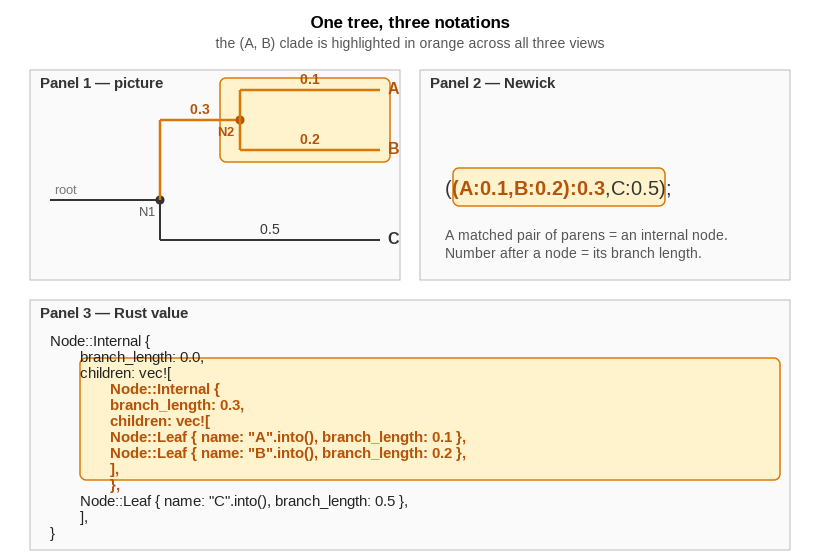
Node::Internal { ... } block.
A worked example
The tree ((A:0.1, B:0.2):0.3, C:0.5); (Newick notation) has:
- Three tips: A, B, C
- Root has two children: an internal node (branch 0.3, parents of A and B) and the tip C (branch 0.5)
count_tips= 3max_depth(from root to farthest tip) = 0.3 + 0.2 = 0.5 (or 0.5 via the C branch — same value here, coincidentally)total_branch_length= 0.1 + 0.2 + 0.3 + 0.5 = 1.1
The exercise
cd day3/ex-phylo-treeImplement Node, count_tips, max_depth, and total_branch_length. Make all eight tests pass.
The starter file already defines two small helpers — leaf(name, bl) and internal(bl, children) — used by the tests to build trees concisely. Do not change them.
How to run
cargo test
cargo run    # prints stats for a built-in sample tree
Hints
The enum has two variants with named fields. Derive Debug and Clone:
#[derive(Debug, Clone)]
enum Node {
    Leaf {
        name: String,
        branch_length: f64,
    },
    Internal {
        branch_length: f64,
        children: Vec<Node>,
    },
}
Why no Box? Because Vec<Node> already stores the children on the heap. The Internal variant’s size on the stack is just three pointers (the Vec header) plus an f64 plus the enum tag — fixed and known.
Inside match you destructure each variant’s fields. Use .. to ignore the fields you do not care about:
match node {
    Node::Leaf { .. } => 1,
    Node::Internal { children, .. } => {
        // children: &Vec<Node>
    }
}count_tips
A leaf is one tip; an internal node has as many tips as the sum of its children. The function is recursive:
fn count_tips(node: &Node) -> usize {
    match node {
        Node::Leaf { .. } => 1,
        Node::Internal { children, .. } => {
            let mut total = 0;
            for child in children {
                total += count_tips(child);
            }
            total
        }
    }
}
(On a later pass you can replace the inner loop with children.iter().map(count_tips).sum(), which uses Iterator::sum — same answer, more idiomatic.)
max_depth
Depth from this node to the farthest descendant. For a leaf, that is just its own branch length. For an internal node, it is its own branch length plus the maximum of the children’s depths:
fn max_depth(node: &Node) -> f64 {
    match node {
        Node::Leaf { branch_length, .. } => *branch_length,
        Node::Internal { branch_length, children } => {
            let mut deepest: f64 = 0.0;
            for child in children {
                let d = max_depth(child);
                if d > deepest {
                    deepest = d;
                }
            }
            branch_length + deepest
        }
    }
}
Note *branch_length to dereference the &f64 we get from pattern-matching on &Node.
total_branch_length
Sum every branch length in the tree:
fn total_branch_length(node: &Node) -> f64 {
    match node {
        Node::Leaf { branch_length, .. } => *branch_length,
        Node::Internal { branch_length, children } => {
            let mut total = *branch_length;
            for child in children {
                total += total_branch_length(child);
            }
            total
        }
    }
}
Solution
See day3/ex-phylo-tree-solution/src/main.rs for the complete reference, including the leaf and internal helpers used by the tests.
The three function bodies are exactly the ones in the hints above.
Where this leads
- Day 4 (optional): parse a real Newick string into a
Nodetree. Newick parsing has subtleties (nested parentheses, quoting) but is a fun puzzle. - The most recent common ancestor of two tips — a classic recursive tree operation — would be the natural next function. We will leave it as a homework challenge for students who finish early.
- For production phylogenetics work in Rust, the
light_phylogenycrate exists; the larger ecosystem is still maturing.