Exercise: k-mers as slice views
Goal
Write kmers(seq: &[u8], k: usize) -> Vec<&[u8]>: return every contiguous window of length k in seq, in order, as a vector of slice views into seq.
Crucially, the returned slices borrow from the input — no copying. If the input is 1 GB, this function still only allocates a small Vec of slice metadata.
Background
A k-mer is a contiguous subsequence of length k. k-mers are the working currency of much of modern bioinformatics: alignment-free comparison, sequence indexing, error correction, de Bruijn graph assembly, classifier features. Counting k-mers efficiently — without copying the underlying bytes — is fundamental.
In ACGTA with k=3, the k-mers are:
A C G T A
| | |
+-+-+        ACG
  | | |
  +-+-+      CGT
    | | |
    +-+-+    GTA
So kmers(b"ACGTA", 3) should return [b"ACG", b"CGT", b"GTA"] — three slice views, no allocated bytes.
Why slice views, not Vec<Vec<u8>>?
If we returned Vec<Vec<u8>>, every k-mer would be a separate heap allocation containing a copy of those bytes. For a 100 Mb genome and k=21, that is ~100 million 21-byte allocations and ~2 GB of duplicated data. Returning Vec<&[u8]> instead returns ~100 million 16-byte pointer+length pairs (~1.5 GB) without duplicating a single base. On day 3 we will see how iterators avoid even that allocation.
The lifetime of the returned slices is tied to seq. Rust elides the annotation because there is only one input reference, so the compiler infers that the output must borrow from it. (You will see explicit lifetime annotations later in the week.)
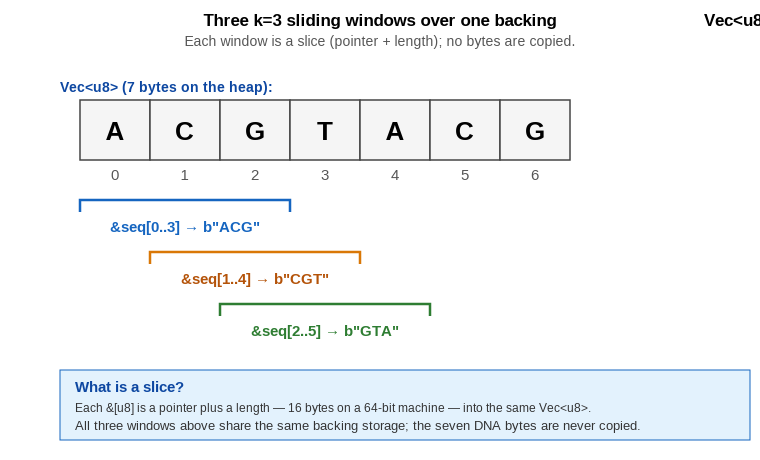
b"ACGTACG". Each window is a &[u8] slice — a pointer-plus-length pair — pointing into the same backing Vec<u8>. The seven DNA bytes are never copied; the output Vec<&[u8]> only stores three slice descriptors.
The exercise
cd day2/ex-kmersMake all six tests pass.
How to run
cargo test
cargo run -- ACGTA 3   # expected: ACG CGT GTA
cargo run -- ACGT 4    # expected: ACGT
cargo run -- AC 3      # expected: (no k-mers; k is larger than the sequence)
Hints
What should the function return when:
k == 0?k > seq.len()?seqis empty?
In all three cases there are no k-mers. Return an empty Vec early so the rest of the function can assume 1 <= k <= seq.len():
if k == 0 || k > seq.len() {
    return Vec::new();
}The first k-mer starts at index 0; the last starts at index seq.len() - k (inclusive). So the loop runs over 0..=seq.len() - k:
for i in 0..=seq.len() - k {
    // window is &seq[i..i + k]
}
The inclusive range ..= includes the upper bound. With seq = "ACGTA" (len 5) and k = 3, this gives i = 0, 1, 2, which produces three k-mers — correct.
Solution
fn kmers(seq: &[u8], k: usize) -> Vec<&[u8]> {
    if k == 0 || k > seq.len() {
        return Vec::new();
    }
    let mut out: Vec<&[u8]> = Vec::with_capacity(seq.len() - k + 1);
    for i in 0..=seq.len() - k {
        out.push(&seq[i..i + k]);
    }
    out
}
Full reference in day2/ex-kmers-solution/src/main.rs.
Where this leads
- Day 3: rewrite using the built-in
<[T]>::windowsiterator, which yields exactly the same slices without the explicit loop, and without even allocating the outerVecif you consume the iterator directly. We will also use this to build aHashMap<Vec<u8>, usize>k-mer counter. - Day 5: parallelise k-mer counting across many sequences with
rayon.