Exercise: Reverse complement
Goal
Write reverse_complement(seq: &[u8]) -> Vec<u8>: given a DNA sequence as a byte slice, return a newly-allocated Vec<u8> containing the complement of each base in reverse order.
This is the first exercise where the function owns the data it returns. The caller is given a fresh Vec<u8> they can mutate, store, or drop as they wish — the function keeps nothing.
Background
The reverse complement is one of the most common operations in bioinformatics. To compute it, complement each base (A↔︎T, C↔︎G) and reverse the order. Aliasing on day 1: ATGCATGC → complemented TACGTACG → reversed GCATGCAT. We will reuse the complement_base function from day 1.
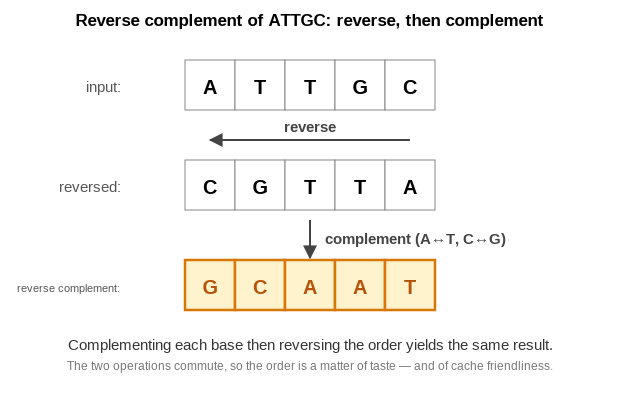
ATTGC: reverse the order, then complement each base. Doing it in the opposite order — complement first, then reverse — produces the same result, because the two operations commute.
The exercise
cd day2/ex-reverse-complementMake all seven tests pass.
How to run
cargo test
cargo run -- ATGCATGC    # expected: GCATGCAT
cargo run -- AAAA        # expected: TTTT
cargo run -- ACGT        # expected: ACGT  (this DNA sequence is a palindrome)
Hints
Vec::with_capacity(n) creates an empty vector that has already reserved space for n items. Compared to Vec::new(), this avoids the vector having to grow (and reallocate) as you push into it:
let mut out: Vec<u8> = Vec::with_capacity(seq.len());You know exactly how big the result will be — same length as the input — so allocate exactly that much.
A range like 0..seq.len() walks indices forward. To walk them backward, call .rev() on it:
for i in (0..seq.len()).rev() {
    // i goes from seq.len()-1 down to 0
}
On day 3 we will write the same loop more compactly with seq.iter().rev().map(...).collect(), but the indexed loop is fine for today and easier to read while learning.
Vec::push appends a single element:
out.push(complement_base(seq[i]));When the loop ends, the bare name out (no ;) is your return value.
Solution
fn reverse_complement(seq: &[u8]) -> Vec<u8> {
    let mut out: Vec<u8> = Vec::with_capacity(seq.len());
    for i in (0..seq.len()).rev() {
        out.push(complement_base(seq[i]));
    }
    out
}
Full reference in day2/ex-reverse-complement-solution/src/main.rs.
Where this leads
- Next exercise (02): rewrite this so the caller passes in a buffer to fill, instead of allocating a fresh
Vecon every call. That is how every fast bioinformatics tool actually does it in its inner loop. - Day 3: rewrite the body as one iterator chain —
seq.iter().rev().map(|&b| complement_base(b)).collect(). - Day 12 exercise 4: rewrite this as a
wgpucompute shader — same complement table, now applied by thousands of GPU threads in parallel. Side-by-side with this CPU version, the GPU wins on multi-megabyte inputs once the data is already on the device.