Exercise: a trainable promoter classifier
Goal
Build a tiny promoter classifier [a neural network that says “this DNA sequence looks like a promoter” vs “this looks like random DNA”] using Burn’s Module system and train it with autodiff and Adam.
Architecture:
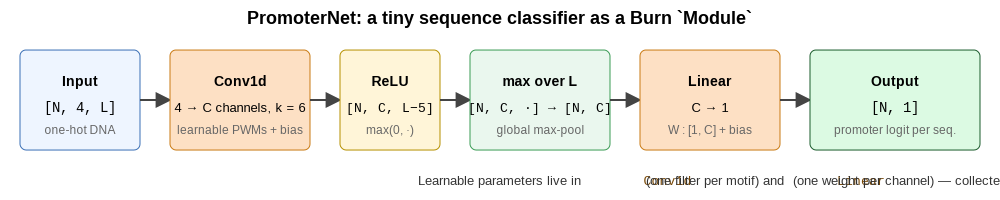
The synthetic data: half the sequences have a TATAAA-like motif planted in them (“promoters”, label 1.0); the other half are random (“non-promoters”, label 0.0). After a couple of hundred Adam steps, the network should classify both groups with high accuracy.
By the time cargo test passes you will have used Module, Conv1d, Linear, Autodiff, Optimizer, and AdamConfig.
Background — a Module is a struct of parameters plus forward
A Burn Module [the trait that marks a struct as containing trainable parameters; deriving it lets Burn collect, save, load, and gradient-step those parameters] is the Rust equivalent of PyTorch’s nn.Module:
use burn::module::Module;
use burn::nn::{Linear, LinearConfig};
use burn::nn::conv::{Conv1d, Conv1dConfig};
use burn::tensor::{Tensor, backend::Backend};

#[derive(Module, Debug)]
pub struct PromoterNet<B: Backend> {
    conv: Conv1d<B>,
    fc:   Linear<B>,
}
import torch.nn as nn
class PromoterNet(nn.Module):
def __init__(self, kernel: int, channels: int):
super().__init__()
self.conv = nn.Conv1d(in_channels=4, out_channels=channels, kernel_size=kernel)
self.fc = nn.Linear(channels, 1)
def forward(self, x):
h = self.conv(x).relu() # [N, C, L-k+1]
h, _ = h.max(dim=2) # global max-pool → [N, C]
return self.fc(h) # [N, 1]The training loop in Burn:
let loss = (logits - labels).powf_scalar(2.0).mean();   // MSE on logits
let grads = loss.backward();
let grads = GradientsParams::from_grads(grads, &model);
model = optim.step(lr, model, grads);
The PyTorch equivalent:
loss = (logits - labels).pow(2).mean()
optim.zero_grad()
loss.backward()
optim.step()
The only structural difference is ownership — Burn’s optim.step takes the model and returns the updated model rather than mutating in place.
The exercise
Open day11/ex-promoter-classifier/. The starter contains:
- The
PromoterNet<B: Backend>struct, with itsConv1dandLinearfields already declared. - The
newconstructor, fully written. - The
forwardmethod body —// TODOfor you to fill in. - A
train_stepfunction —// TODOfor the four-line training body. - A
mainthat builds synthetic data, callstrain_step200 times, and reports final accuracy. - Three unit tests: forward-shape, gradient-flow, and end-to-end accuracy after training.
You may not change the function signatures or the tests.
How to run
cd day11/ex-promoter-classifier
cargo test                              # all three tests must pass
cargo run                               # 200 training steps + accuracy printout
When the bodies are right:
test result: ok. 3 passed; 0 failed; 0 ignored; 0 measuredHints
Four chained operations:
use burn::tensor::activation::relu;

fn forward(&self, x: Tensor<B, 3>) -> Tensor<B, 2> {
    let h: Tensor<B, 3> = relu(self.conv.forward(x));     // [N, C, L-k+1]
    let h: Tensor<B, 2> = h.max_dim(2).squeeze_dim(2);    // [N, C]
    self.fc.forward(h)                                    // [N, 1]
}
ReLU is a free function in burn::tensor::activation, not a method on Tensor. max_dim(dim) returns the max along that axis, keeping the rank with a size-1 axis; .squeeze_dim(2) drops it.
let logits = model.forward(x);
let loss = (logits - y).powf_scalar(2.0).mean();
let loss_value: f32 = loss.clone().into_data().to_vec::<f32>().unwrap()[0];
let grads = loss.backward();
let grads = GradientsParams::from_grads(grads, &model);
let model = optim.step(lr, model, grads);
Six lines: forward, loss, extract value for logging, backward, gradient bookkeeping, optimiser step. The optimiser returns the new model — bind it back to the same name so the next iteration uses the updated parameters.
Pulling a single f32 out of a scalar tensor goes through into_data().to_vec::<f32>() because Burn keeps the element type generic in B::FloatElem. The .unwrap()[0] is the conventional shortcut.
We use MSE rather than binary cross-entropy here because it is one line and is enough to get the classifier learning on this synthetic problem. In real work you would use BinaryCrossEntropyLossConfig on top of a sigmoid — same structure, more numerically stable.
The type alias for the training backend is:
type Train = Autodiff<NdArray>;Autodiff<B> wraps any other backend and records every tensor operation so that .backward() knows how to propagate gradients. The forward pass is identical to the non-autodiff version; you only pay for the extra bookkeeping when you call .backward().
At test/inference time you can use plain NdArray and skip the overhead.
Solution
impl<B: Backend> PromoterNet<B> {
    pub fn forward(&self, x: Tensor<B, 3>) -> Tensor<B, 2> {
        let h = relu(self.conv.forward(x));
        let h: Tensor<B, 2> = h.max_dim(2).squeeze_dim(2);
        self.fc.forward(h)
    }
}

fn train_step<B, O>(
    model: PromoterNet<B>,
    optim: &mut O,
    lr: f64,
    x: Tensor<B, 3>,
    y: Tensor<B, 2>,
) -> (PromoterNet<B>, f32)
where
    B: AutodiffBackend,
    O: Optimizer<PromoterNet<B>, B>,
{
    let logits = model.forward(x);
    let loss = (logits - y).powf_scalar(2.0).mean();
    let loss_value: f32 = loss.clone().into_data().to_vec::<f32>().unwrap()[0];
    let grads = loss.backward();
    let grads = GradientsParams::from_grads(grads, &model);
    let model = optim.step(lr, model, grads);
    (model, loss_value)
}
The full reference is in day11/ex-promoter-classifier-solution/src/main.rs.
Where this leads
- Replace MSE with binary cross-entropy and add a sigmoid layer — better calibrated probabilities.
- Add more conv layers to see longer-range context — this is the path that ends at Basenji / Enformer.
- Save and load the trained model with
burn::record— the Burn analogue oftorch.save/torch.load. - Train on a real dataset — DeepBind used ChIP-seq peaks for ~500 transcription factors; the architecture is exactly this network with more filters.
This is the end of day 11 — you now have a complete GPU-ready Rust pipeline from raw DNA strings to a trained binary classifier.