Exercise: A second table and a join
Goal
Add a second table — assay, holding growth-rate measurements — and link it to the strain table from exercise 01 with a foreign key. Then combine the two with NATURAL JOIN and INNER JOIN so you can ask questions like “what is the mean OD₆₀₀ at 24 h for each species, in LB?”.
After this exercise the first-half SQL material is done — the rest of day 7 is the same database, but driven from Rust.
Background
We have measurements of optical density at 600 nm (OD₆₀₀) at 24 h of growth for each strain in our collection, across a few different media. Some strains have been measured multiple times, in different media or on different days. One row per measurement:
| Column | Type | Notes |
|---|---|---|
assay_id |
INTEGER | primary key |
strain_id |
INTEGER | foreign key → strain(strain_id) |
medium |
TEXT | LB / M9-glucose / TSB / BHI |
od600_24h |
REAL | optical density reading |
date_measured |
TEXT | ISO YYYY-MM-DD |
24 rows ship in data/assays.csv. Each assay.strain_id points to a row in strain.strain_id. That is what makes the data relational — one strain can have many assays, but every assay belongs to exactly one strain.
The exercise
Reset to a clean state, then re-open. The seed file rebuilds the schema and inserts both tables:
cd day7/ex-sqlite-strains
rm -f strains.db
sqlite3 strains.db < data/seed.sql
sqlite3 strains.db
At the sqlite> prompt:
.headers on
.mode column
.tables             -- should show: strain   assay
.schema assay       -- inspect the new table
SELECT COUNT(*) FROM assay;   -- expect 24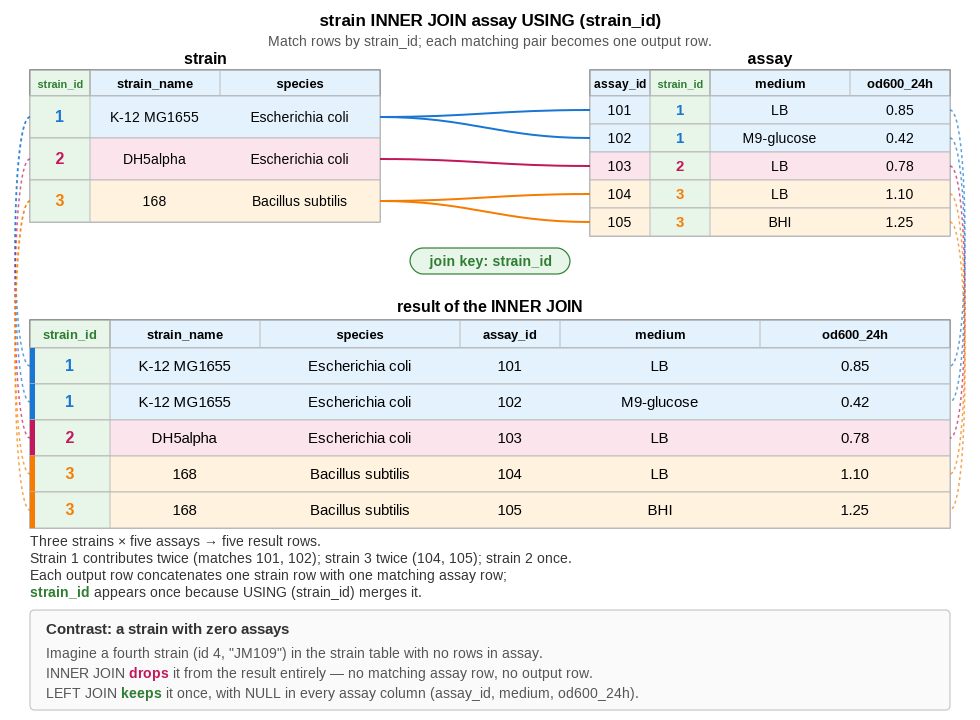
INNER JOIN matches rows from the two tables wherever the join key (strain_id) is equal on both sides. One strain can produce multiple result rows when it has multiple matching assays (strain 1 → assays 101 and 102; strain 3 → assays 104 and 105). A strain with no matching assay would be dropped from the result entirely — that is the defining behaviour of INNER JOIN. If you wanted to keep such a strain (with NULLs in the assay columns), you would use LEFT JOIN instead.
Step 1 — explicit INNER JOIN
Combine each assay with its strain by matching assay.strain_id to strain.strain_id:
SELECT s.strain_name, s.species, a.medium, a.od600_24h
FROM strain AS s
INNER JOIN assay AS a ON a.strain_id = s.strain_id
LIMIT 5;
AS sandAS aare short aliases.ON a.strain_id = s.strain_idis the join condition.INNER JOIN(or justJOIN) keeps only rows where the condition matches on both sides.
Step 2 — the same thing as NATURAL JOIN
Both tables have a column literally called strain_id and only that column matches across the two schemas. So you can write:
SELECT strain_name, species, medium, od600_24h
FROM strain NATURAL JOIN assay
LIMIT 5;
NATURAL JOIN joins on every same-named column automatically. Output is identical to Step 1. Convenient when your schema is designed with that in mind; rarely seen in real production code, because adding a column later can silently change the join. Use it once today; reach for JOIN … ON from then on.
Step 3 — filter then join
Find every LB measurement for E. coli strains:
SELECT s.strain_name, a.medium, a.od600_24h, a.date_measured
FROM strain AS s
JOIN assay  AS a ON a.strain_id = s.strain_id
WHERE s.species = 'Escherichia coli'
  AND a.medium  = 'LB'
ORDER BY a.date_measured, s.strain_name;
The WHERE clause can mention columns from either table — the join happens conceptually first.
Step 4 — aggregate after the join
Mean OD per species, restricted to LB:
SELECT s.species,
       COUNT(*)             AS n_measurements,
       ROUND(AVG(a.od600_24h), 2) AS mean_od
FROM strain AS s
JOIN assay  AS a ON a.strain_id = s.strain_id
WHERE a.medium = 'LB'
GROUP BY s.species
ORDER BY mean_od DESC;
AVG and COUNT are aggregate functions — they reduce a group of rows to a single value. The output is one row per species; the grouping is what GROUP BY does.
Step 5 — your turn
Write SQL to answer each of these. Try before peeking.
(a) For each strain, how many assays have been recorded?
SELECT s.strain_name, COUNT(a.assay_id) AS n
FROM strain AS s
JOIN assay  AS a ON a.strain_id = s.strain_id
GROUP BY s.strain_name
ORDER BY n DESC, s.strain_name;
(b) Which strain has the highest single OD₆₀₀ measurement, and in what medium?
SELECT s.strain_name, a.medium, a.od600_24h
FROM strain AS s
JOIN assay  AS a ON a.strain_id = s.strain_id
ORDER BY a.od600_24h DESC
LIMIT 1;
PAO1 in LB, OD = 1.97.
(c) Across all media, what is the mean OD₆₀₀ for each (species, medium) pair? (Two grouping columns, not one.)
SELECT s.species, a.medium,
       COUNT(*)              AS n,
       ROUND(AVG(a.od600_24h), 2) AS mean_od
FROM strain AS s
JOIN assay  AS a ON a.strain_id = s.strain_id
GROUP BY s.species, a.medium
ORDER BY s.species, a.medium;
Step 6 — a strain with no assays
To see why INNER JOIN is sometimes the wrong tool, insert a strain that has zero measurements:
INSERT INTO strain (strain_name, species, isolation_source, year_isolated)
VALUES ('JM109', 'Escherichia coli', 'lab derivative', 1985);

SELECT s.strain_name, COUNT(a.assay_id) AS n
FROM strain AS s
JOIN assay  AS a ON a.strain_id = s.strain_id
GROUP BY s.strain_name;
JM109 does not appear — INNER JOIN dropped it because there is no matching assay row.
Swap the join type:
SELECT s.strain_name, COUNT(a.assay_id) AS n
FROM strain AS s
LEFT JOIN assay AS a ON a.strain_id = s.strain_id
GROUP BY s.strain_name
ORDER BY n, s.strain_name;
LEFT JOIN keeps every row from the left table (strain), filling NULLs where there is no match on the right. Now JM109 shows up with n = 0. This is one of the most common SQL bugs in practice — a missing strain disappears because someone reached for INNER JOIN by reflex.
Hints
assay?
.schema assay always shows you. If you forget the table name, .schema with no argument shows every table’s CREATE statement.
You wrote SELECT strain_id in a query that joins two tables both having a strain_id. Either qualify the column (s.strain_id) or, in NATURAL JOIN, leave it unqualified — NATURAL JOIN merges the two into one. Mixing the two patterns is what triggers the error.
GROUP BY and SELECT rules
Every non-aggregate column in SELECT should also be in GROUP BY. SQLite is forgiving and will pick some value for an unlisted column, but PostgreSQL and most other databases reject it as a hard error. Get into the habit early.
Where this leads
- Exercise 03 — open
strains.dbfrom Rust and read the rows out. - Joins on three or more tables (a transitive join across
strain→assay→medium_metadata) work the same way: chain moreJOIN ... ON ...clauses. JOINoperations are the part of SQL that pays for indexes. Once a table has tens of millions of rows, anINDEXon the join column turns a 10-second query into a 1-millisecond one. Out of scope today; worth Googling once you hit it in real work.