Exercise: Sequence alignment with dynamic programming
Goal
Implement Needleman–Wunsch global alignment for two DNA sequences:
fn align(a: &[u8], b: &[u8]) -> AlignmentAlignment is a struct containing the optimal score and the two aligned sequences (with b'-' representing a gap). Scoring is fixed: match +1, mismatch -1, gap -1.
This is your first dynamic programming algorithm. It is also the conceptual backbone of every pairwise alignment tool (BLAST seeds, minimap2, exonerate, …).
Background
Suppose you want to align two sequences. The naive recursive definition writes itself:
align(a, b) = max(
    align(a[:-1], b[:-1]) + score(a[-1], b[-1]),   // match or mismatch
    align(a[:-1], b)      + gap,                    // gap in b
    align(a,      b[:-1]) + gap                     // gap in a
)
That recursion has exponential running time because it visits the same subproblem many times. Dynamic programming is exactly the trick of computing each subproblem once and storing the answer in a table — memoised recursion, but iterative. Build a (n+1) × (m+1) matrix where score[i][j] is the optimal alignment score for a[..i] against b[..j]. Fill it top-left to bottom-right; the answer is in score[n][m].
To recover the alignment itself (not just the score) we also keep a traceback matrix that records, for every cell, which of the three neighbours we came from. Walking back from score[n][m] to score[0][0] reads the aligned sequences out in reverse.
A worked example
a = "ACGT", b = "AGGT". The optimal alignment uses no gaps — three matches and one mismatch (C vs G) — for a score of 1 + 1 + 1 + 1 - 1 - 1 = 2. The aligned sequences are just the inputs themselves: ACGT over AGGT.
For a = "ACGT", b = "ACT" the optimal score is 2 (three matches and one gap), with an alignment like
A C G T
A C - T
The filled matrix for that pair, with one interior cell expanded to show where its value came from:
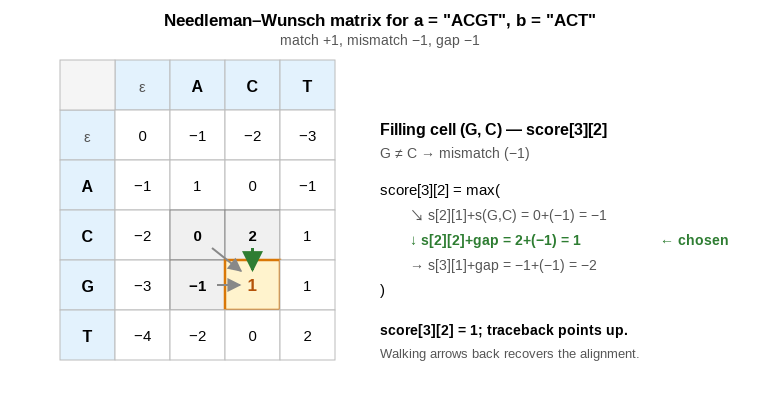
ACGT vs ACT. Each interior cell is the maximum over three neighbours — diagonal (match/mismatch), up (gap in b), or left (gap in a). The arrow into the highlighted cell records which neighbour won, and walking those arrows back from the bottom-right corner reconstructs the alignment.
The exercise
cd day3/ex-alignmentThe starter defines Direction (an enum tracking which neighbour each cell came from), Alignment (the result struct), and a function shell align(...) with three TODO blocks: initialise, fill, traceback.
Make all seven tests pass.
How to run
cargo test
cargo run -- ACGT AGGT   # score 2, ACGT / AGGT (no gaps needed)
cargo run -- ACGT ACT    # score 2, ACGT / AC-T (one gap)
Hints
You need a (n+1) × (m+1) matrix for scores and a same-sized matrix for traceback directions. Two-dimensional vectors are written Vec<Vec<...>>. Use the vec! macro to create them filled with a default value:
let n = a.len();
let m = b.len();
let mut score: Vec<Vec<i32>>       = vec![vec![0; m + 1]; n + 1];
let mut from: Vec<Vec<Direction>> = vec![vec![Direction::End; m + 1]; n + 1];The cell score[i][0] represents aligning a[..i] against an empty b — that means inserting i gaps into b, so its score is i * GAP. Symmetrically for the first row:
for i in 1..=n {
    score[i][0] = (i as i32) * GAP;
    from[i][0]  = Direction::Up;   // we came from row i-1
}
for j in 1..=m {
    score[0][j] = (j as i32) * GAP;
    from[0][j]  = Direction::Left; // we came from column j-1
}
score[0][0] is left as 0, from[0][0] as End — the traceback’s stopping condition.
For each interior cell, take the max of the three options. Remember that a and b are zero-indexed but our matrix is one-indexed (so cell (i, j) looks at a[i-1] and b[j-1]):
for i in 1..=n {
    for j in 1..=m {
        let s = if a[i - 1] == b[j - 1] { MATCH } else { MISMATCH };
        let diag = score[i - 1][j - 1] + s;
        let up   = score[i - 1][j]     + GAP;
        let left = score[i]    [j - 1] + GAP;

        // pick the maximum, remembering where it came from
        if diag >= up && diag >= left {
            score[i][j] = diag;
            from[i][j]  = Direction::Diag;
        } else if up >= left {
            score[i][j] = up;
            from[i][j]  = Direction::Up;
        } else {
            score[i][j] = left;
            from[i][j]  = Direction::Left;
        }
    }
}Walk back through the from matrix, pushing characters onto two output vectors. Each step writes one column of the alignment:
let mut aligned_a: Vec<u8> = Vec::new();
let mut aligned_b: Vec<u8> = Vec::new();
let (mut i, mut j) = (n, m);
while i > 0 || j > 0 {
    match from[i][j] {
        Direction::Diag => {
            aligned_a.push(a[i - 1]);
            aligned_b.push(b[j - 1]);
            i -= 1;
            j -= 1;
        }
        Direction::Up => {
            aligned_a.push(a[i - 1]);
            aligned_b.push(b'-');
            i -= 1;
        }
        Direction::Left => {
            aligned_a.push(b'-');
            aligned_b.push(b[j - 1]);
            j -= 1;
        }
        Direction::End => break,
    }
}
aligned_a.reverse();   // we built them back-to-front
aligned_b.reverse();
<[T]>::reverse reverses a slice in place — the cheapest way to fix the order.
Solution
The full reference solution combines all four hints into a single align function — see day3/ex-alignment-solution/src/main.rs.
The three phases (init → fill → traceback) are independent enough that you can develop and verify them one at a time. The tests are deliberately permissive about which optimal alignment is returned when there are several — they check the score precisely, but for the aligned sequences they verify properties (length, gap-removal recovers input) rather than exact bytes wherever ambiguity exists.
Where this leads
- Local alignment (Smith–Waterman) is the same algorithm with two tiny changes: any cell can be reset to
0, and the traceback starts at the maximum cell anywhere in the matrix. - Affine gap penalties (different cost for opening vs extending a gap) require two extra matrices. Standard, but more bookkeeping.
- For production alignment use
rust-bio(bio::alignment) orblock-aligner— both ship optimised SIMD implementations. - Day 5: measure how much the
--releaseflag changes the running time of this implementation on a slightly larger input.