Exercise: Quality trimming as a slice view
Goal
Write quality_trim(qual: &[u8], min_score: u8) -> &[u8]: given a FASTQ quality string (Phred+33 encoded — see day 1 exercise 4) and a minimum quality score, return the largest interior slice of qual whose endpoints both pass the threshold.
That is: trim low-quality bases from the start and the end, but leave the middle alone.
The function returns a &[u8] — a view into the input — not a new Vec<u8>. No bytes are copied.
Background
Per-end quality trimming is the simplest quality-control step in any sequencing pipeline. (Real tools like cutadapt or fastp use sliding-window averages; we will stay simpler for today.) Conventionally:
- Move the start index forward as long as the leading base is below threshold.
- Move the end index backward as long as the trailing base is below threshold.
- Return the slice
&qual[start..end].
The input quality is stored as Phred+33 bytes (so '!' = score 0, 'I' = score 40); the threshold is given as a score. Convert the score to a byte threshold by adding 33.
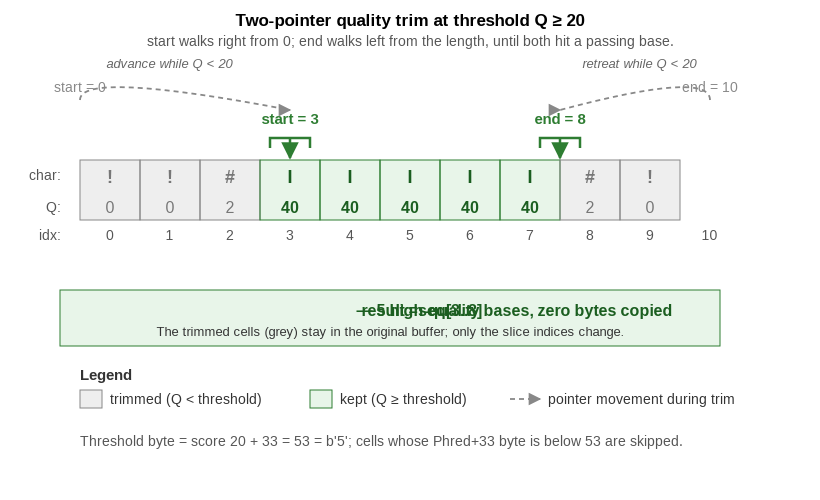
start walks rightward from 0 until it lands on a passing base (index 3); end walks leftward from 10 until it lands just past one (index 8). The function returns &qual[3..8] — five bases, no bytes copied.
Why a slice, not a Vec?
Returning &[u8] means the function performs zero allocation. The returned slice points into the same memory as qual. The caller can use it for as long as qual itself is alive — the borrow checker tracks this for you, with no annotations needed (single input reference → its lifetime is the output’s).
The exercise
cd day2/ex-quality-trimMake all seven tests pass.
How to run
cargo test
# A FASTQ quality string of "!!IIII!!" trimmed at score 30:
# bytes:  ! ! I I I I ! !
# scores: 0 0 40 40 40 40 0 0
# trimmed (drop leading and trailing low):  I I I I
Hints
The quality bytes are Phred+33-encoded, so a score q is stored as the byte q + 33. Compute the byte threshold once at the start of the function:
let threshold = min_score + 33;After this, every comparison is just qual[i] >= threshold.
Walk the start index forward while the leading byte fails the threshold. Use a while loop:
let mut start: usize = 0;
while start < qual.len() && qual[start] < threshold {
    start += 1;
}
The start < qual.len() check is essential — without it, indexing past the end of the slice would panic. The short-circuit && guarantees qual[start] is only evaluated when start is in range.
Symmetrically, walk the end index backward while the trailing byte fails:
let mut end: usize = qual.len();
while end > start && qual[end - 1] < threshold {
    end -= 1;
}
The end > start guard is important: if every byte is below threshold, this loop should leave end == start, returning an empty slice. (Without the guard the loop would underflow end and panic.)
The final expression is the slice:
&qual[start..end]No ;, no allocation — just a view.
Solution
fn quality_trim(qual: &[u8], min_score: u8) -> &[u8] {
    let threshold = min_score + 33;
    let mut start: usize = 0;
    while start < qual.len() && qual[start] < threshold {
        start += 1;
    }
    let mut end: usize = qual.len();
    while end > start && qual[end - 1] < threshold {
        end -= 1;
    }
    &qual[start..end]
}
Full reference in day2/ex-quality-trim-solution/src/main.rs.
Where this leads
- Day 3: rewrite with
<[T]>::iter().position()andrposition()— same algorithm, no explicit loop, no mutable counters. - Day 4: apply this to every read of a real
.fastq.gzstreamed throughnoodles-fastq, then write the trimmed reads to a new file.